Dec 11, 2025
 3 min read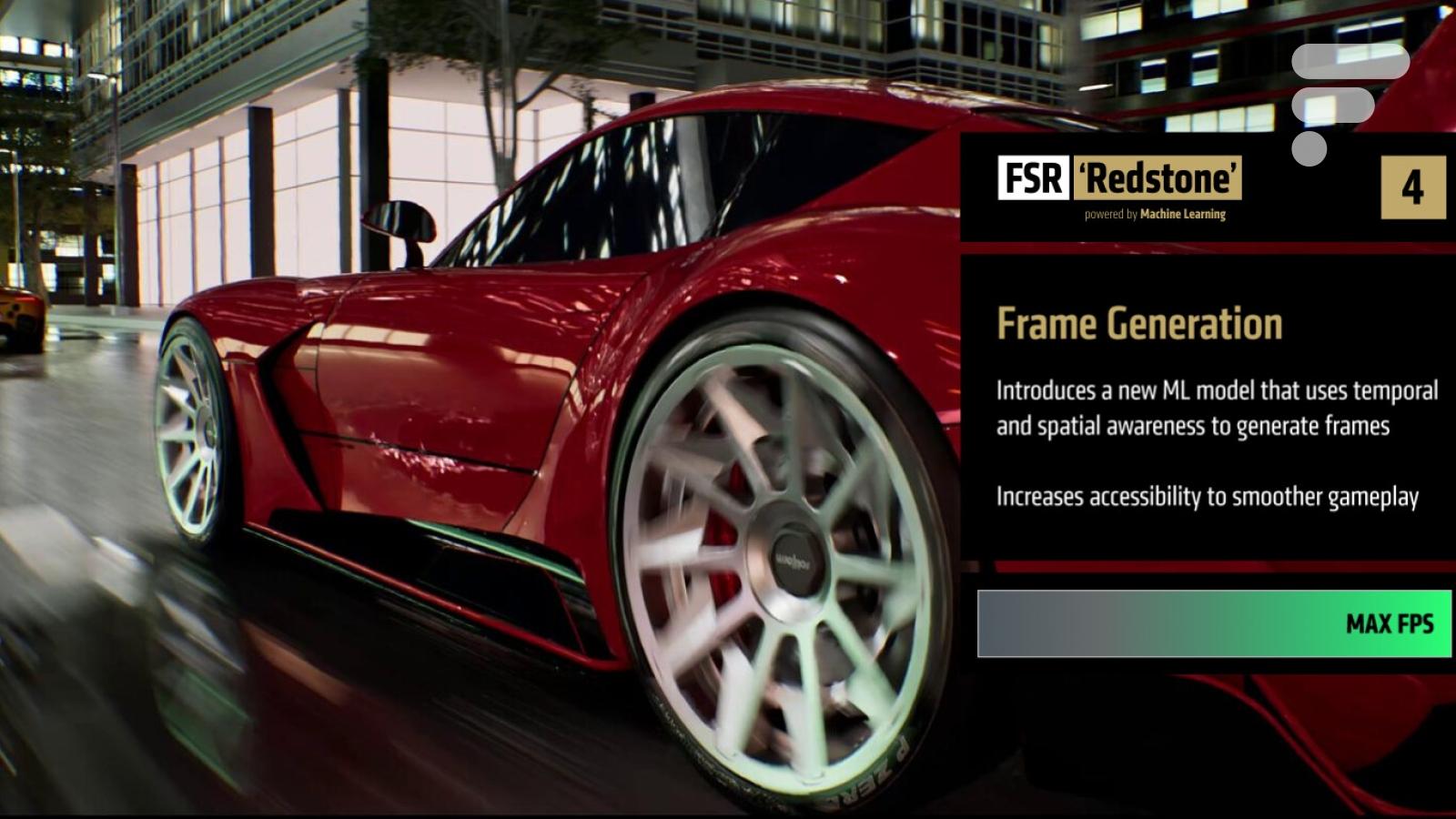
In early 2025, AMD announced a new version of its upscaling technology, FSR 4. For the first time, AMD graphics cards will finally rely on artificial intelligence accelerator cores to offer image quality similar to NVIDIA's DLSS.
This is the first step in the main FSR Redstone project, a codename that includes new technologies integrated into FSR to improve the performance and image quality of your games, always thanks to machine learning.
After a short beta phase, AMD officially announces the availability of its new suite of developer tools.
All the new features of AMD FSR Redstone
We already know the four Power FSR Redstone technologies, along with two new features that focus on ray tracing and path tracing.Here's how they work, and specifically how they can visually impact your games.
FSR Radiance Caching, accelerated global illumination
AMD is introducing two new technologies that aim to improve the quality and performance of ray tracing and path games.FSR Radiance Caching is a technique that accelerates the generation of ray tracing light using machine learning.
Paradoxically, this means saving the GPU from the high workload of repeating the light for each cross, creating a more efficient light.
Radiance caching significantly improves image quality, especially when the indirect lighting and global lighting options are enabled.The model learns the realistic behavior of light and its propagation over multiple surfaces before improving its rendering in real-time games.
The technology is available to game creators today and will enter the first titles in 2026. Warhammer 40,000: Darktide will soon integrate it.
FSR-ray generation, to erase beam tracing flaws
The generation of FSR Fray is ARD's proposal to answer Nvidia's ray feedback.It involves providing realistic and self-reflective lighting by adjusting the so-called "neural Network Denoiser" with key Ray Tracing functionality.
Instead of using a human algorithm, train the next generation on millions of images to remove noise and potential defects from X-ray images.
We therefore end up with much better quality reflections, especially in puddles or smooth surfaces such as metal or marble.
The feature is already available in Call of Duty.in Black Ops 7 and new titles are expected to follow soon.
Frame generation finally relies on artificial intelligence
The graphics generation at AMD is global and can be used for its own GPU, but also the competition.
But AMD still lacks technology that harnesses all the power and precision of machine learning to produce stable transient images in real time.Now the same thing is happening with FSR Redstone.
AMD announced that its neural network is "trained on a variety of motion scenarios" to reduce artifacts such as ghosting.
So, we can expect less artifacts and better image quality in games with natively integrated FSR redstone frame generation.
The fourth feature we already know is an expansion that includes this year's FSR 4 offerings to be included in the full package.
4 km of a combination of different technologies. With the help of 40 km.
It is available to all developers, but not to all players
Game developers can already work on implementing various FSR Redstone SDK designs into their games.
But all these technologies are RDNA 4 generation graphics cards, that is. It has been confirmed that this year's RDNA 4 generation graphics cards will be exclusive to RDNA 4 generation cards.For the previous generation, Redstone is based on AI. Instead, Advanced and Horizon models will be called Analytical models.
In comparison, all NVIDIA RTX graphics cards support DLSS 4 preprocessing and contributions to Ray reconstruction.We sincerely hope that AMD will extend its support to owners of older models by 2026.
This content has been blocked because you have not accepted cookies and other trackers.This content is provided by Disqus.
See, you must accept the use of not using your data that contains advertising and personal advertising content and the content of this site and evaluate the seditor) and evaluate-box.
By clicking on "I Accept Everything", you agree to the stated reasons for all cookies and other trackers placed by Humanoid and its partners.
You can withdraw your consent at any time.For more information, we invite you to read our cookie policy.
Manage my options