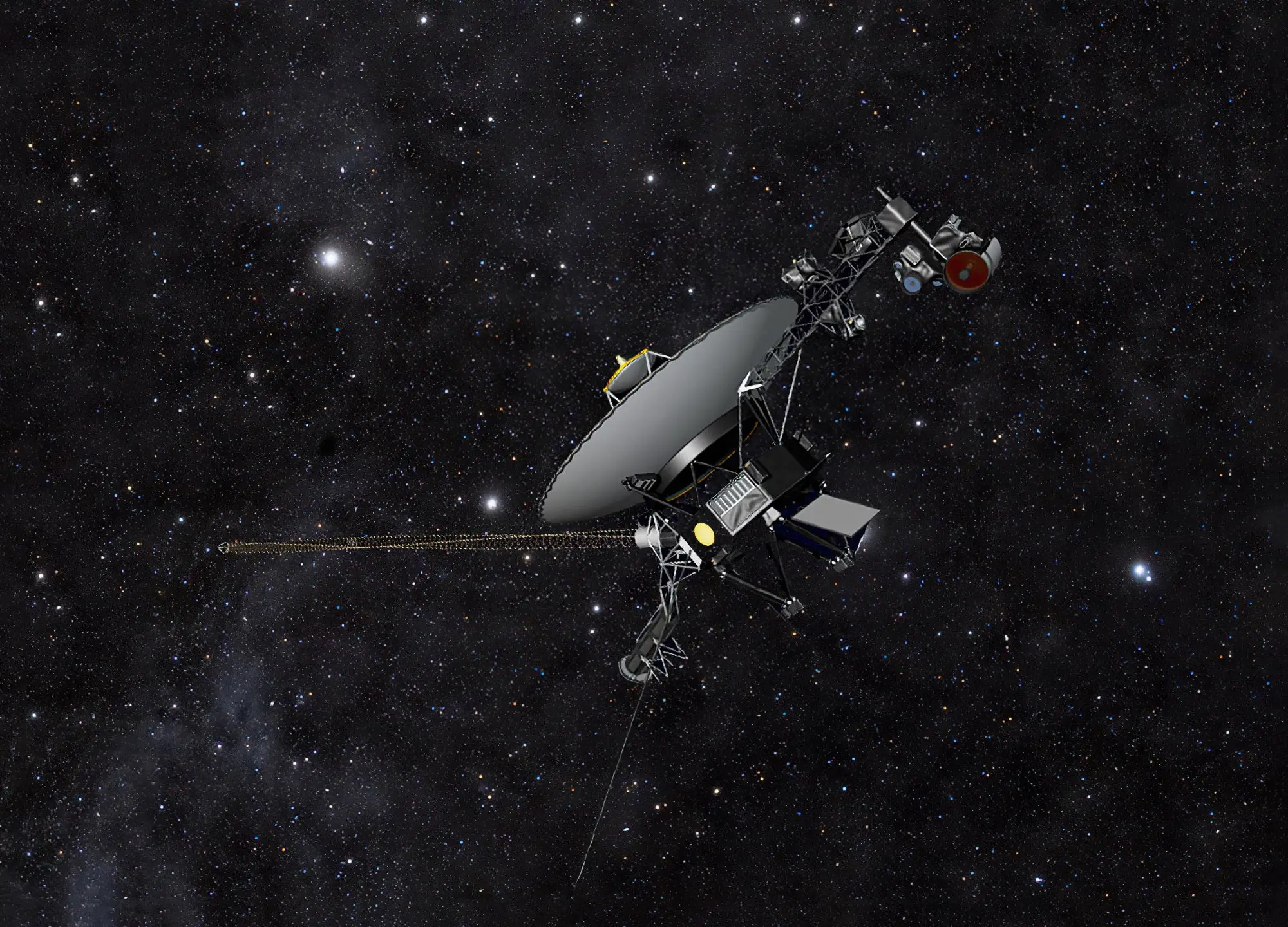
Le concept de cet artiste montre le vaisseau spatial Voyager de la NASA contre un champ d’étoiles dans l’obscurité de l’espace. Les deux vaisseaux spatiaux Voyager voyagent de plus en plus loin de la Terre, lors d’un voyage dans l’espace interstellaire, et finiront par orbiter autour du centre de la Voie lactée. Crédit : NASA/JPL-Caltech
Le plan permettra aux instruments scientifiques de Voyager 2 de fonctionner pendant quelques années de plus que prévu, permettant ainsi davantage de découvertes depuis l’espace interstellaire.
Lancé en 1977, le vaisseau spatial Voyager 2 se trouve à plus de 12 milliards de miles (20 milliards de kilomètres) de la Terre, utilisant cinq instruments scientifiques pour étudier l’espace interstellaire. Pour aider à maintenir ces appareils en marche malgré la diminution des alimentations électriques, le vaisseau spatial vieillissant a commencé à utiliser un petit réservoir d’alimentation de secours mis de côté dans le cadre d’un mécanisme de sécurité embarqué. Cette décision permettrait à la mission de retarder la fermeture d’un instrument scientifique jusqu’en 2026, au lieu de cette année.
Éteindre un instrument scientifique ne finira pas le travail. Après avoir arrêté un instrument en 2026, la sonde continuera d’alimenter quatre instruments scientifiques jusqu’à ce qu’une alimentation électrique faible nécessite l’arrêt d’un autre. Si Voyager 2 reste en bonne santé, l’équipe d’ingénierie s’attend à ce que la mission se poursuive dans les années à venir.

Le modèle de test de preuve Voyager, affiché dans la salle de simulation spatiale du JPL en 1976, était une réplique exacte des sondes spatiales jumelles Voyager lancées en 1977. La plate-forme d’arpentage du modèle s’étend vers la droite, contenant plusieurs des instruments scientifiques du vaisseau spatial en le publiant. . postes. Crédit : NASA/JPL-Caltech
Voyager 2 et son jumeau, Voyager 1, sont les deux seuls engins spatiaux à opérer en dehors de l’héliosphère, la bulle protectrice des particules et des champs magnétiques générés par le soleil. Les sondes aident les scientifiques à répondre aux questions sur la forme et le rôle de l’héliosphère dans la protection de la Terre contre les particules énergétiques et autres rayonnements dans l’environnement interstellaire.
a déclaré Linda Spilker, scientifique du projet Voyager[{ » attribute= » »>NASA’s Jet Propulsion Laboratory in Southern California, which manages the mission for NASA.
Power to the Probes
Both Voyager probes power themselves with radioisotope thermoelectric generators (RTGs), which convert heat from decaying plutonium into electricity. The continual decay process means the generator produces slightly less power each year. So far, the declining power supply hasn’t impacted the mission’s science output, but to compensate for the loss, engineers have turned off heaters and other systems that are not essential to keeping the spacecraft flying.
With those options now exhausted on Voyager 2, one of the spacecraft’s five science instruments was next on their list. (Voyager 1 is operating one less science instrument than its twin because an instrument failed early in the mission. As a result, the decision about whether to turn off an instrument on Voyager 1 won’t come until sometime next year.)

Each of NASA’s Voyager probes are equipped with three radioisotope thermoelectric generators (RTGs), including the one shown here. The RTGs provide power for the spacecraft by converting the heat generated by the decay of plutonium-238 into electricity. Credit: NASA/JPL-Caltech
In search of a way to avoid shutting down a Voyager 2 science instrument, the team took a closer look at a safety mechanism designed to protect the instruments in case the spacecraft’s voltage – the flow of electricity – changes significantly. Because a fluctuation in voltage could damage the instruments, Voyager is equipped with a voltage regulator that triggers a backup circuit in such an event. The circuit can access a small amount of power from the RTG that’s set aside for this purpose. Instead of reserving that power, the mission will now be using it to keep the science instruments operating.
Although the spacecraft’s voltage will not be tightly regulated as a result, even after more than 45 years in flight, the electrical systems on both probes remain relatively stable, minimizing the need for a safety net. The engineering team is also able to monitor the voltage and respond if it fluctuates too much. If the new approach works well for Voyager 2, the team may implement it on Voyager 1 as well.
“Variable voltages pose a risk to the instruments, but we’ve determined that it’s a small risk, and the alternative offers a big reward of being able to keep the science instruments turned on longer,” said Suzanne Dodd, Voyager’s project manager at JPL. “We’ve been monitoring the spacecraft for a few weeks, and it seems like this new approach is working.”
The Voyager mission was originally scheduled to last only four years, sending both probes past Saturn and Jupiter. NASA extended the mission so that Voyager 2 could visit Neptune and Uranus; it is still the only spacecraft ever to have encountered the ice giants. In 1990, NASA extended the mission again, this time with the goal of sending the probes outside the heliosphere. Voyager 1 reached the boundary in 2012, while Voyager 2 (traveling slower and in a different direction than its twin) reached it in 2018.
More About the Mission
Jet Propulsion Laboratory (JPL), a division of Caltech in Pasadena, built and operates the Voyager spacecraft. The Voyager missions are a part of the NASA Heliophysics System Observatory, sponsored by the Heliophysics Division of the Science Mission Directorate in Washington.